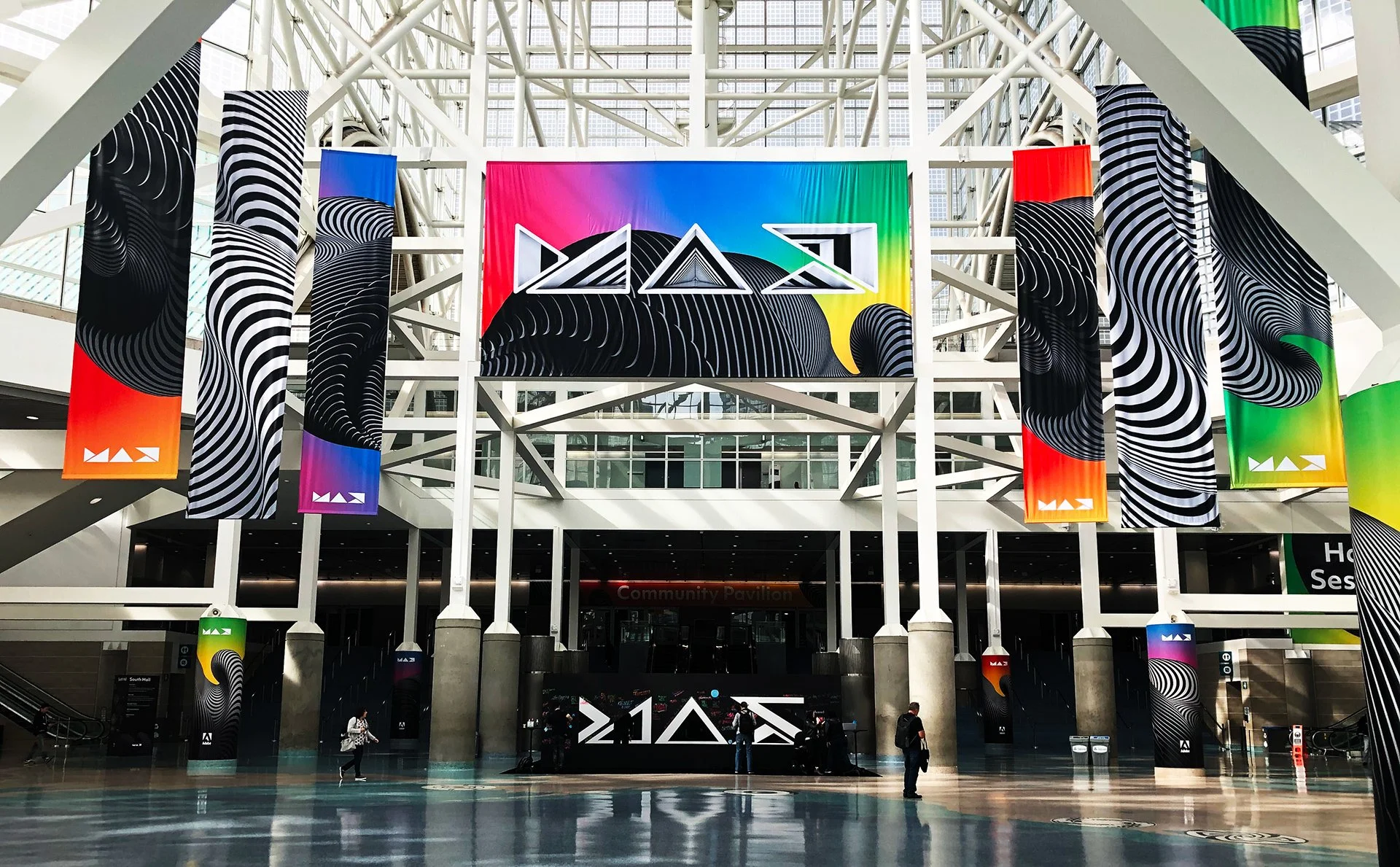
The Creativity Conference November 4th-6th, 2019, Los Angeles, CA
The Spark
In 2019, I attended the Adobe MAX Creativity Conference in Los Angeles with two teammates from TracyLocke. One session in particular left a lasting impression: Enabling 2D Designers to Push the Boundaries of Creativity, led by Adobe Senior Product Designer Erin Kim. It introduced Adobe Dimension, a new Creative Cloud tool that gave 2D designers a simple way into the world of 3D.
At the time, it felt like a curiosity. I wasn’t looking for a new workflow, but the potential stuck with me. The interface was familiar, the learning curve was approachable, and for the first time, 3D felt creatively accessible without the steep barriers of traditional modeling software. What I didn’t realize then was that this session would lay the groundwork for a much bigger shift ahead.
Exploring the Tools
In 2020, I was working on the DIAGEO business when the pandemic brought production work to a halt. It felt like the right moment to revisit the idea of 3D and find a way to integrate it into our creative workflow. Adobe Dimension stood out. It was already part of our Creative Cloud license and used familiar Adobe tools, which meant the team could pick it up quickly without formal training. That was important to me. I wasn’t looking to become the dedicated 3D designer. I wanted a solution the entire team could use. The only challenge was the lack of assets. Dimension’s built-in model library was limited, and Adobe Stock didn’t offer the branded products we needed. That’s when I turned to Blender.
blender gave me the ability to create custom 3D assets from scratch, solving the biggest barrier to bringing 3D into our creative process. While I used blender for modeling, I intentionally kept rendering and scene building in Dimension. This hybrid approach allowed me to supply the team with high-quality models they could use immediately in a familiar environment.
Building the Solution
My early Blender work focused on filling asset gaps. Sometimes we didn’t have product imagery because a new SKU had launched. Other times, we couldn’t shoot due to COVID-19 restrictions. And often, we simply wanted to avoid defaulting to generic, straight-on bottle shots. I began modeling what we couldn’t source and created accurate, brand-ready bottles that unlocked more freedom in how we told visual stories.
The Reward
As I gained momentum, I expanded into more complex builds. I began designing off-premise retail displays and on-premise custom elements, turning rough concept sketches into photorealistic mockups. These models helped our team sell in ideas earlier and more effectively.
I also discovered an unexpected advantage. By exporting UV maps from my 3D models, I could provide early die-lines to production teams, which helped streamline approvals and shorten timelines. Over time, I refined a hybrid workflow — modeling in Blender, rendering in Dimension — that gave our team new creative flexibility without requiring them to learn 3D from the ground up.
The Results
The impact of this hybrid workflow was immediate and lasting. It allowed our team to continue producing high-quality creative without relying on in-person photoshoots, which was critical during the height of the pandemic. Because Adobe Dimension required little to no training, other designers were able to jump in quickly, using the models I created to build their own visuals. This not only scaled the use of 3D across the team but also reduced our production spend during a period of extreme budget sensitivity. By introducing early 3D concepting and sharing UV maps with production, we were able to accelerate approvals and compress timelines. What began as a personal learning initiative evolved into a scalable solution that reshaped how the team approached asset creation and storytelling.